


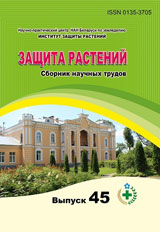
The collection presents materials of scientific research on the species composition, biology, ecology and harmfulness of weeds, insects and pathogens of agricultural crops. The effectiveness and environmental safety of agrotechnical, biological and chemical measures to optimize the phytosanitary situation of agrocenoses are presented. The collection is included in the list of scientific publications of the Republic of Belarus for publishing the results of dissertation research. The collection is indexed in the Russian Science Citation Index (RSCI). Full texts of articles are available on the website of the Scientific Electronic Library eLIBRARY.RU at: https://www.elibrary.ru/contents.asp?titleid=74824
Current issue
HERBOLOGY
The results of the research on the efficiency of the herbicide Proponit Duo, EC (propisochlor 720 g/l+сlomazonem 30 g/l) in industrial crops (rape, sugar beet, sunflower) are presented. One month after the treatment, the number and vegetative mass of annual weeds decreased by 87.8–100%, and in sunflower - by 68.4–87.3%. A reliably saved yield was obtained for all crops; a slight phytotoxic effect of the herbicide was noted, manifested in leaves whitening, which disappeared within a month.
The paper presents the results of the research on the biological and economic efficiency of the herbicide Stingray, EC (pinoxaden, 50 g/l + cloquintocet-mexil, 12,5 g/l /antidote/), produced by the Avgust company, Russia. It’s established that when protecting winter triticale at the tillering stage in spring with the application rate of 0,6–0,9 l/ha, the reduction of annual grass weeds infestation amounts to 77,9–85,7% in terms of number and 84,1–91,5% – in terms of the vegetative mass; in winter barley it is 91,7–94,4% and 97,4–98,7 respectively. With the application rate of 0.9–1.2 l/ha at the elongation stage the death of all annual grass weeds in winter triticale is 75,0–81,3 %, the vegetative mass decreases by 76,1–85,1%; in winter barley – 85,7–92,9% and 97,4–98,7 %. Based on the findings, the herbicide Stingray, EC is included in the State Register of Plant Protection Products and Fertilizers permitted for the use in the Republic of Belarus.
The long-term research on the study and introduction of such a crop as phacelia tanacetifolia in the honey-seed production under the conditions of the Republic of Belarus made it possible to propose the elements of cultivation technologies, which allowed farmers and beekeepers to create continuously flowering arrays, not only increasing the productivity of apiaries, but also obtaining seeds, which could be sold after processing. On average, for 2023–2024, the maximum seed yield of 8,49–8,63 c/ha was ensured with row sowing (15 cm), a seeding rate of 12 kg/ha and the herbicide mesotrione, 480 g/l (Egida, SC® (0,2–0,3 l/ha). Weeding was a significant reserve for obtaining higher yields of the crop, since in weedy areas the seed yield of phacelia tanacetifolia was 5,86–6,84 c/ha.
PHYTOPATHOLOGY
The article presents the results of research for 2023–2024 on assessing the susceptibility of winter barley varieties to leaf apparatus diseases in the conditions of Belarus. It was revealed that the development of powdery mildew reached 28.0% (Izotsel variety), rhynchosporiosis 4.4% (Bazhan variety), rhynchosporiosis – 9.4% (Alexander variety), net spot – 37.2% (Venice variety), dwarf rust – 43.7% (Adalina variety).
The article presents the results of studies on the biological effectiveness of two-component and three-component fungicides in protecting sunflower from alternaria, sclerotinia and gray rot.
The biological efficiency of a three -component drug based on the active substances of pidiflometofen, 75 g/l + azoxistrin, 125 g/l + diphenonosol, 125 g/l in a rate of flow rate 1.0 l/ha with two -year use as a result of two -year studies against alternariosis in the “lemon ripe” stage amounted to 68.7–69.7 %,, sclerotiniosis – 81.8–94.9 %, gray rot – 63.4–89.8 %, two -component fungicides based on azoxistobine, 125 g/l + diphenonazole, 125 g/l - 68,2–77.9 %; 81.8–100 %; 81,1–87.8 % and azoxistobine, 200 g/l + cyproponazole, 80 g/l – 60.1–78.7 %; 81.4–81.8 %; 85.7–93.5, respectively. The use of fungicid data made it possible to preserve 3.8–4.9 c/ha.
The paper presents the two year data on the biological efficiency of fungicides application against brown spot on garden strawberry leaves. In field experiments the biological efficiency of the studied fungicides amounted to 36.6%-86.3%, depending on the active ingredient, weather conditions and the nature of the disease development.
The article presents the results of a study on the sensitivity of dominant Fusarium species isolated from winter wheat plants (root system and grain) collected in six regions of the Republic of Belarus to fungicidal active substances widely used for protecting the crop from root rot and Fusarium head blight. A significant variation in the degree of sensitivity of Fusarium pathogens to all tested fungicides was revealed. It was found that the most common Fusarium species showed varying sensitivity to the fungicidal substances in in vitro conditions. Differences in sensitivity to all fungicides included in the study were not detected only in the F. culmorum population.
Data on the development of root rot and Fusarium head blight in winter wheat crops during 2023–2024 are presented. The degree of plant infection with root rot ranged from 11,8 to 36,5 %, and with Fusarium head blight from 0,0 to 10,4 %. Species identification of 190 fungal isolates of the Fusarium genus, isolated from infected plant parts, was confirmed using real-time PCR. It was established that the species composition of this genus on winter wheat is represented by 8 species. The fungus F. oxysporum dominated on the root system of the crop, while F. poae dominated on the grain.
The paper presents the results of the research on the biological efficiency of the contact fungicide Polidok, WDG against pomaceous fruits diseases. It’s established that the application of the Polidok, WDG at a rate of 2,25 kg/ha in the protection system of apple and pear trees effectively inhibits the development of diseases during vegetation.
As a result of a two-year study, it has been established that a four-fold application of the fungicide Polidok, WDG during the periods most vulnerable to diseases ensures the reduction of apple scab development: on leaves – up to 83,9 %, on fruits – up to 81,4 %; pear scab: on leaves – up to 71,2 %, on fruits – up to 63,6 %, pear rust – up to 76,0 % and saves the yield of pomaceous fruits up to 22,2–36,0 c/ha.
The article presents data on the incidence of bacterial diseases in potato tubers, which ranged from 0,6 % to 1,8 % in 2020-2024. The prevalence of black leg during the vegetation period in potato agrocenoses was shown to reach a maximum of 13,7 % in 2023. Immunochromatographic analysis of plants with signs of black leg allowed the identification of both the causative agents of this disease, Pectobacterium atrosepticum and Dickeya dianticola, and the latent agents of ring rot, Clavibacter michiganensis subsp. sepedonicus and Clavibacter michiganensis subsp. michiganensis. Diagnosis of plant samples without external symptoms of bacterial diseases using enzyme-linked immunosorbent assay revealed a latent form of material infection with bacterial pathogens. The prevalence of C. michiganensis subsp. sepedonicus reached 23,3 %, and P. atrosepticum reached 31,7 %.
The paper presents the long-term data (2013–2022) on the species composition of fungi contaminating sunflower seed material in Belarus. Seed infection with Alternaria blight, Fusarium wilt, gray mold, and saprophytic fungi is determined. The main pathogens of sunflower oilseed diseases of the genera Alternaria Nees, Fusarium Link., Botrytis P. Micheli ex Haller, Cladosporium Link., Mucor Fr., Rhizopus Ehrenb., and Penicillium Link. are identified.
ENTOMOLOGY
The article presents the results of long-term studies (2018–2023) to assess the effectiveness of combined insecticides against rape blossom beetle in spring rape crops. It was found that double treatment with preparations based on a complex of two or three active substances (imidacloprid + alpha-cypermethrin, imidacloprid + bifenthrin, imidacloprid + lambda-cyhalothrin, bifenthrin + thiamethoxam + alpha-cypermethrin, lambda-cyhalothrin + acetamiprid + clothianidin) ensures a decrease in the number of rape blossom beetle to 69,5–92,0% and obtaining 8,3–26,3% of reliably preserved seed yield of the crop.
The article considers the results of studies on the efficacy of products for pre-sowing treatment of corn seeds based on insecticide imidacloprid, 600 g/l (Imidashans–C, CS, Coyote, CS, Sidoprid, TKS); 200 g/l (Imidor Pro, CS and Commander, VRK); thiamethoxam, 600 g/l (Harita, CS) to protect corn during the initial period of development from larvae of the genera: Agriotes, Athous, and Selatosomus. The biological efficacy in reducing plant damage by the pest was 82,5–90,5 %.
The main mass of Ostrinia nubilalis Hbn. ovipositions (22,6 %) was found on the 7th leaf, 20,6 % on the 6th leaf, and 16,2 % on the 4th leaf. When vegetative plants were treated with single-component insecticides containing chlorantraniliprole, the damage to corn stalks caused by phytophagous caterpillars decreased by 82,4–96,2 %, with s. c. spinetoram – by 95,9–100 %, two-component preparations with s. c. imidacloprid, 150 g/l + lambda-cyhalothrin, 50 g/l – 86,2–93,1 %, lambda-cyhalothrin, 50 g/l + chloranthraniliprol, 100 g/l – 96,2–100 %. By reducing the harmfulness of the pest, 4,3–13,0 centners per hectare of grain or 5,7–14,1 % were saved compared to the non-treated option.
The article describes the phytosanitary situation regarding grain infestation with arthropods that developed in seed granaries in 2021–2023. A set of protective measures against storage pests, which includes two stages: preparation of grain storage facilities (unloaded) and protection of cereal grain seeds during storage (loaded). In unloaded storage facilities, preventive and extermination (chemical) measures are mandatory. In loaded storage facilities, tactics for protecting seeds of spring (storage 9 months) and winter and spring cereal grain crops of insurance and mobile funds (storage 13–24 months) based on monitoring by selecting average samples and of pheromone-sticky traps, disinsection with preparations taking into account the species composition, structure of dominance, harmfulness of pests, total infestation density (TID) of grain by arthropods, temperature factor and seasonality.
The article presents the of the research on evaluating the efficiency of the insecticide Faschans, EC (alpha-cypermethrin, 100 g/l) in winter and spring rape crops. Biological effectiveness from 82,2 to 90,0 % is maintained for a week after double spraying and allows preserving 6,8–14,1 % of winter rape seeds and 13,3–17,5 % of spring rape seeds.
In laboratory experiments conducted in 2019–2020 the sensitivity of spider mite greenhouse population (Tetranychus urticae Koch) on potted blackberry and cherry crops to the acaricides Masai, WP (tebufenpyrad, 200 g/kg); Envidor Plus, SC (abamectin, 18 g/l + spirodiclofen, 222 g/l); Topazio, WDG (sulfur, 800 g/kg) and Apollo, SC (clofentezine, 500 g/l) was assessed. It was established that at a high density of the population (up to 430 individuals per leaf on average), the phytophage was the most sensitive to the acaricide Massai, WP. With diagnostic concentration of the preparation (twice higher than the recommended one), the mite mortality was 63,9–72,0 %. With a low density of spider mite populations (up to 24 individuals per leaf on average), relatively high sensitivity (47.6 %) to the acaricide Apollo SC was observed. The reduction of phytophage numbers with a single acaricide application did not exceed 10,5%, while with a double application the reduction was 47,6%. The biological preparations Entolec, L and Melobass provide efficiency of 56,5% and 62,3% respectively against the phytophage. Predatory mite Amblyseius (Amblyseius cucumeris Oud.) reduces the phytophage numbers by 67,5 % on the 10th day at a ratio of 1:5.
The article considers the issue of improving the technology of carrot cultivation in the dining room while protecting crops from carrot flies. The analysis of phytophagous damage to crops in the phase of 2–3 leaves and 4–5 leaves is given. The assessment of the biological and economic effectiveness of the insecticide Actara, EDG with various doses of the drug on canteen carrots in the conditions of the «Olgovskoye» production cooperative of the Vitebsk region of Belarus is given.
GENERAL ISSUES OF PLANT PROTECTION
The results of studies on isolation and antagonistic activity of symbiotic bacteria of entomopathogenic nematodes are presented. 6 isolates of bacteria belonging to the genus Xenorhabdus were obtained. It was revealed that the obtained isolates exhibit a high level of antibacterial and antifungal activity. It has been shown to inhibit the growth of phytopathogenic bacteria of the genera Clavibacter, Pectobacterium, Pseudomonas and phytopathogenic micromycetes of the genera Alternaria, Rhizoctonia and Phytophthora.
The effect of technological additives introduced at the post–fermentation stage on entomopathogenic fungi, the basis of biological preparations, has been studied in vitro. It was found that the addition of magnesium sulfate, iron sulfate, sunflower oil, rapeseed oil, dimethylsulfoxide, and 2-aminopentanedioic acid contributes to the increased viability and biological activity of the strains.
GENERAL ISSUES OF PLANT PROTECTION
The paper presents the data on the impact of chemical and biological protection products on the nutritional value and yield of green pea. It was established that in the intensive system of protection the saved yield was 7,9 c/ha (16,9%), in the green one – 11,6 % (5,4 c/ha) in comparison with the option without applied protection products (46,7 c/ha). Due to the conducted biochemical analysis it was identified that the maximum content of dry matter (30,16 %) and sugar (5,43%) was observed in the option with the intensive protection system. The content of crude protein varied from 25,61 (control) to 28,72 % (green system) and crude fat was 5–13 % higher in the green protection system. The amount of crude fiber and ash differed insignificantly between the options under experiment.
The methodology for microdetermination of flonicamid in apples, soil and water is developed. The method is based on the extraction of flonicamid from water, soil, and apples using organic solvents, purification of the extracts on a silica gel column and subsequent determination by gas-liquid chromatography. The detection limit (mg/kg) is: water – 0,001; soil, apples – 0,05.
The behavior of active ingredients of new multicomponent fungicides was studied. Prothioconazole, pyraclostrobin, and cyproconazole were not detected in winter wheat grain on the 30th day and spiroxamine, tebuconazole, and triadimenol were not detected on the 73rd day after treatment during harvest. Azoxystrobin and difenoconazole were not detected in winter rape seeds and oil on the 39th day after treatment. Cyprodinil and fludioxonil of 0,0518 and 0,0484 mg/kg respectively were detected in apples on the 3rd and 13th days after double treatment, which was below the maximum permissible level of 1,0 mg/kg. If application rates and waiting periods are observed, agricultural products are not contaminated with residues of fungicide active ingredients.


